DNJ Mulberry Leaf Extract
Mulberry leaf extract, standardized for 1-deoxynojirimycin (DNJ) content, available in various concentrations.
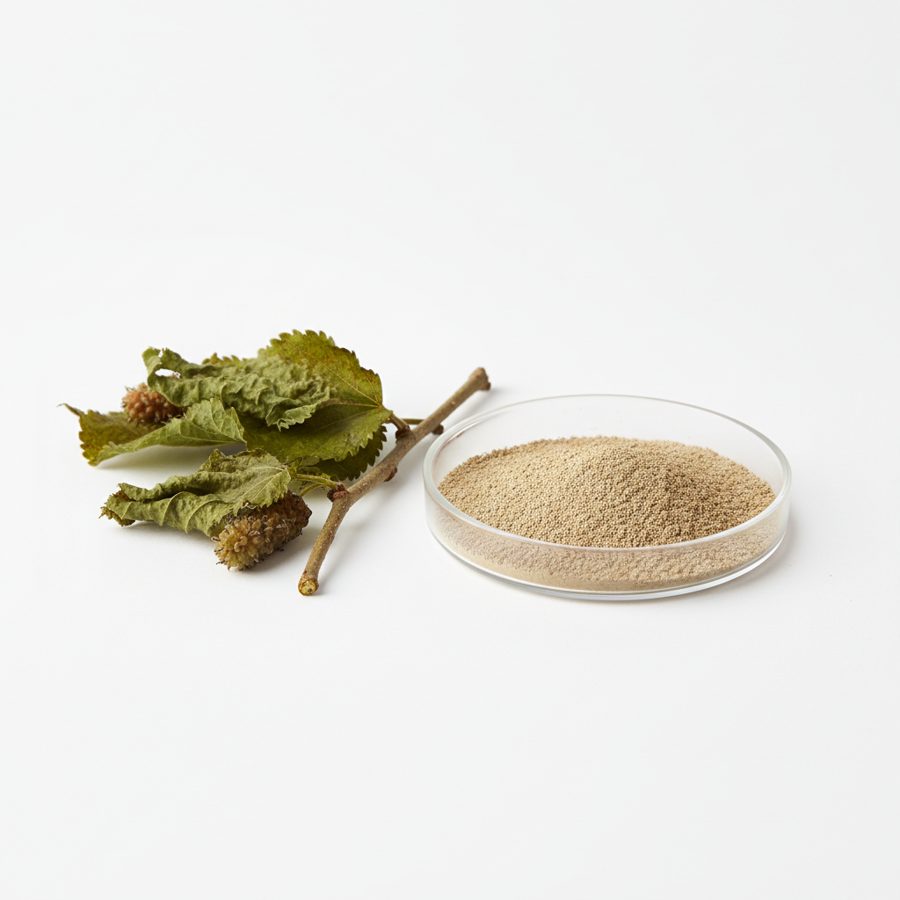
Technical specification
- Specification
- 1%,2%,5%,10% 1-DNJ
- Test method
- HPLC/UV
- Grade
- Food Grade, Pharmaceutical Grade
- Synonyms
- 1-Deoxynojirimycin
- Apperance
- Brown powder
- Shelf time
- 2 years,keep away sunlight, keep dry
- Plant sources
- Mulberry Leaf Extract
Quality parameters (COA)
| Items | Result | Specification |
|---|---|---|
| 1-DNJ | 5.02% | 5% |
| Organoleptic | — | — |
| Appearance | Conforms | Fine Powder |
| Color | Conforms | Brown yellow powder |
| Odor | Conforms | Characteristic |
| Taste | Conforms | Characteristic |
| Physical Characteristics | — | — |
| Particle Size | Conforms | NLT 100% Through 80 mesh |
| Loss on Drying | Conforms | <=12.0% |
| Ash (Sulphated Ash) | Conforms | <=0.5% |
| Total Heavy Metals | Conforms | ≤10ppm |
| Microbiological Tests | — | — |
| Total Plate Count | Conforms | ≤10000cfu/g |
| Total Yeast & Mold | Conforms | ≤1000cfu/g |
| E.Coli | Negative | Negative |
| Salmonella | Negative | Negative |
| Staphylococcus | Negative | Negative |
Description
DNJ Mulberry Leaf Extract (1-deoxynojirimycin) is derived from the leaves of the mulberry tree (Morus alba). DNJ is a key active compound, and the extract is standardized for its content (1%, 2%, 5%, 10%), confirmed by HPLC/UV methods. The product is available as a powder, which facilitates its dosing and integration into manufacturing processes. The extract exhibits good stability and solubility, which is important for ensuring the uniformity and efficacy of finished products. For procurement specialists, selecting the appropriate DNJ specification (food grade or pharmaceutical grade) depending on the final application is critical. This guarantees that the product meets the required quality and safety standards for use in food supplements and functional products.
Applications
Used in the production of food supplements, functional foods, and beverages aimed at regulating metabolic processes.
Documents
Documents are shared on request after company verification.